Showing posts with label D. Appendix 1: Research for Main Product. Show all posts
Showing posts with label D. Appendix 1: Research for Main Product. Show all posts
Wednesday, 7 December 2016

Monday, 28 November 2016
Tuesday, 22 November 2016
Friday, 11 November 2016
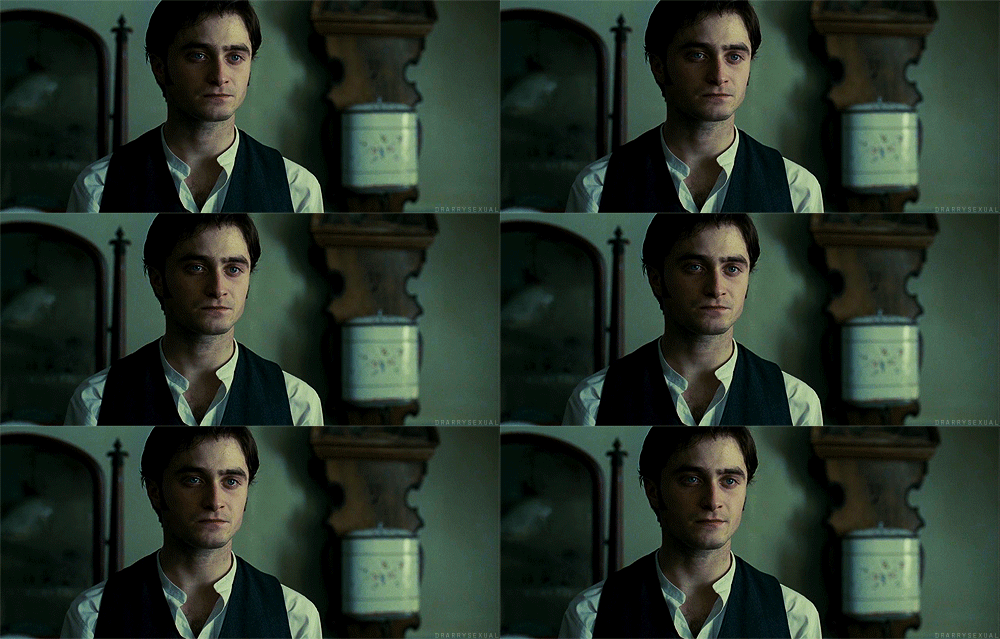
The Woman in Black, Directed by James Watkins (2012)

1. Who do you think the primary and secondary target audience is for The Woman in Black?
 The primary audience for 'The Woman in Black' is predominantly males and females who are under 25, this can mainly be because of the 12A certificate the film was given, meaning that the distributors intended for the target audience to be quite young. The primary target audience is also those who enjoy and are interested in horror and paranormal movies, and enjoy the thrill of watching a horror. The secondary target audience is those who are over 25, mainly the middle class. This is because the film was initially a book that would've had a more mature/middle class audience, the film is also shown in the theater as a play which would also attract a more middle class audience. The use of the play and book means that this middle class audience may potentially be interested in going to see the film. The distributors do not initially set out to target these people for their film, but they are influenced by other factors.
2. How was The Woman in Black marketed?
The Woman in Black was marketed in a way that would maximise its sales and make it a movie that nobody could wait for. There were many different ways that the move was marketed, through the use of social media, teaser campaigns, promotion, the main campaigns and merchandise. The distributors started the campaign with a teaser trailer and poster to create a buzz for the film and to keep people thinking about it until the main trailer was released. It was at this point when Daniel Radcliffe got really invested, and spent a huge amount of time drawing in fans of Harry Potter, to show them that he was capable of more 'mature' acting. After the teaser campaign came the release of the main campaign, this included posters, trailers, radio adverts, social media campaigns as well as large newspaper and magazine coverage. All of these types of advertising allowed the film to appeal to all different audiences, from younger adults, teens and those who were slightly older. The younger audiences would see more of the social media campaigns whereas the older audiences are more likely to see the magazine and newspaper adverts/spreads. A huge way that the film was marketed was through Daniel Radcliffe, due to him being the main character he featured in all of the posters and trailers, using him as the main focus on the posters for the film drew in the 'Harry Potter' audience because they were keen to see him on the big screen again. Daniel Radcliffe also featured on many TV shows to promote the film and encourage people to come and see it upon it's release, he invested large amounts of time into doing Q&As and promotional videos. Due to think 'The Woman in Black' was one of the only horror films to receive this much promotion and publicity.
3. Do you think the marketing materials for the film were appropriate? Why?

I think that the way the film was marketed was extremely clever, the use of teasers before the main campaign allowed people to become interested and invested in the film. the different way in which is was marketed allowed it to have a larger reach and a larger audience. They were also very smart using Daniel Radcliffe as such a main focus on all of their marketing materials as it helped them to draw in a larger audience and create even more of a hype for the film. However, I think that the fact that it was targeted to such a young audience as well as the older audience was not suitable as I believe that many parts of the film were not appropriate for the younger audience it was aimed towards.
4. What kind of release did the film have?
 In the United States the film was released on the 5th of February 2012, on it's opening weekend alone it was shown on 2,885 screens and made approx $20,874,000. A week later, on the 12th February 2012 the film was released in the United Kingdom and was shown across 412 screens, and made approx £3,153,000. When 'The Woman in Black' was at its widest released it was shown in 2,856 theaters and 'The Woman in Black' was shown across 46 different countries in total. This can be considered quite a large release especially for a horror film, especially considering other horror films that year made significantly less during their opening weekends. Sinister only made $18,000,000 later on that year. The film was also given quite a large premiere at the London Royal Festival Hall where thousands of people turned up to see the cast on the red carpet. By June 2012 the film had made approx $127,730,000 making it the highest-grossing British horror film in 20 years!
5. How much did The Woman in Black cost to make? (Production budget) AND what was the industry impact of The Woman in Black?
The production budget of 'The Woman in Black' was estimated at around $17,000,000, meaning that the film made a $2,000,000 profit in the US opening weekend alone. The fact that it earned over $20 million in the US on opening weekend, made it the biggest US opening for a hammer film in all of Hammer history. it also charted 2nd on the box office, only earning approx $1 million less than the movie at No. 1. This caused other distributors and filmmakers to inspire from this films marketing techniques and saw another rise in paranormal movies, using very similar techniques to promote and market their films.
6. Why do you think the film was successful?
The main reason that 'The Woman in Black' was so successful was due to the casting of Daniel Radcliffe. The casting of Daniel Radcliffe attracted a much larger audience towards the film, everybody who enjoyed him in Harry Potter was interested in seeing what else he was capable of and the 'fangirls' were desperate to see him in another film. This is why he was plastered over every campaign they released, he was the main feature on the teaser poster, main poster and he took part in many different promotion techniques to boost the film. The amount of promotion he done for the film and the fact that he was such a main focus in the posters and trailers also meant that people were extremely aware that he would be playing an important role, therefore encouraging them to see the film. The 12A certificate the film was given could also be a reason that it was so successful because it meant that those who had seen Daniel Radcliffe in Harry Potter were able to go and see this film too and it was open to a wider audience.
Thursday, 3 November 2016
Wednesday, 26 October 2016
Tuesday, 18 October 2016
The Cabin in the Woods, Directed by Drew Goddard. (2012)
 |
| THE REPRESENTATION OF WOMEN IN RELATION TO THE CABIN IN THE WOODS |
The 4 character roles for women are domestic, sexual, consumer and marital. The first character role that is portrayed in one of the characters is the Domestic role. We see traits of this role in Dana's character, this is because she is caring towards her friends and is concerned about their well being. We see this when Jules is drunk in the cabin and Dana suggests that she lays down and is clearly worried about her. One of the coordinators, Hadley, even says that he is worried about Dana because of how caring she is. Another one of theses roles we see in the movie is the sexual role, which is portrayed through Jules. Jules is clearly shown as the 'eye candy' throughout the film, we see her being shown in a very provocative way, which is shown when she 'makes-out' with the wolves head and dances in front of the others. She is also the only character to engage in sexual activity in the actual plot time. The other 2 roles are not portrayed in this movie.
2. How is Dana typical of Clover's 'Final Girl' theory? Please mention: the ending, Dana’s appearance and her actions during the film.
 Dana has many traits which make her a typical 'Final Girl' one of the key things is the fact that Dana survives until the end, although we can interpret that she may die after the plot time ends we never see her die in the film. Dana is portrayed as being very academic and aware, she is the one who puts the pieces together and connects what Marty has been saying with what she read in the diary that she found in the basement, such as discovering that the whole thing is a set-up. Dana is also shown as a strong characters, we know this because she attempts to fight back when she gets attacked by one of the zombies, we see this when she stabs one of them repeatedly and pushes the other into the lake, thinking she has defeated him. Dana is also portrayed as slightly androgynous through her appearance and name. The way in which she dresses is quite prudish, especially when compared to Jules', at the start we see Dana in 'granny pants' which reinforces her androgyny. Her name is also not conventionally female, and can be used for both genders.
 3. Jules undergoes mental and physical changes during the film, what are they and how do they cause her to become a horror archetype.

4. Is Mulvey’s Male Gaze theory exemplified in the film and if so, how? Think about framing, camera angles and POV shots.
 We see Mulvey's Male Gaze at may points throughout the film. We sexual and provocative character (Jules) dancing infront of the fireplace sexually, 'making out' with a wolfs head and having sex with her boyfriend on the ground of the woods, The shot of Jules dancing in front of the fire starts by horizontally panning up her body, starting from the bottom of her legs and the slowly up to her bum and then her face. This is the Male Gaze because it is a representation of what a male would do, the scanning up of her body, and can be seen in many films. When Jules is dared to 'make out' with the wolf head, which is displayed on the wall. Without any hesitation Jules walks over to the wolf in a 'model like way' and as she does the camera tracks up her body. This scene, especially the walk has been hypersexualised for the purpose of the male voyeurs. As the 'make out' scene begins a POV shot is used, from the wolfs perspective as Jules flirts with the wolf like it is a human being. After this scene we see Curt and Jules go into the woods to have sex. In this scene we see Jules' boobs, which once again has been done to appeal to the male audience. While Curt and Jules are having sex we see that all of the male staff are watching them, reinforcing that this scene is for the purpose of attracting the male audience. Before Jules takes off her top we hear one of them say "show us the goods" which is extremely objectifying, making Jules an object who is there just to 'show the goods' to males.
5. In the film we, as an audience, are made to be voyeurs: when does this happen and why is it important in regards to representation of character
A voyeur is somebody who gets gratification from watching somebody who is unaware that they are being watched. We see a representation of this towards the beginning of the film, with a one way mirror. This mirror is found by Holden when he first goes into his room and sees a horrific image, due to him finding it bizarre he removes the canvas, revealing the mirror. The mirror shows Dana checking her 'makeup' in the mirror in her room, which is what Holden is seeing. Unaware the Holden can see her Dana begins to get changed right in the view of the mirror, stereotypically we would expect Holden to continue watching and not tell anybody about the mirror. It is at this point we are made to be voyeurs, as we see all of this from Holden's perspective, and we feel involved in his internal debate about whether he should make Dana and the others aware of the mirror or keep it to himself. However, it comes as a shock to the audience when Holden bangs on the wall and tells Dana that he can see her. All of the characters are then surrounded the mirror and Holden offers to swap rooms with Dana, portraying him as a gentleman who doesn't experience enjoyment from being a voyeur. Dana and Holden swap rooms but then the tables are turned and Holden begins to get changed and Dana is the one who is watching him. Her obvious shock, and the fact that she quickly covers up the mirror reinforces her as the 'final girl.'

One other thing that places us in the position of voyeurs is the fact that these coordinators and everybody they work with are watching the teenagers, and they are all completely unaware. These coordinators can see everything that the teens are doing, including when they are getting changed, and we technically see the whole film from this perspective, putting us in their position of voyeurs.
6. Summarise the way women are represented in The Cabin in the Woods. Are they objectified and there to provide satisfaction for heterosexual males and/or do they fulfill another role/purpose?
In Cabin in the Woods the women are objectified for the purpose of satisfaction but they also have other purposes. The film briefly shows the women in a conservative and traditional way, showing traits of domestic and sexual roles, shown to us in the 'Final Girl' theory by Carol Clover. But most of the film shows the two female characters in a progressive way. The differences between Jules and Dana are extremely obvious, Jules in confident and sexy around boys while Dana is not. Jules is portrayed in an objectified and sexual way, while Dana is very conservative and almost prudish, obvious elements of her being the 'final girl.' The Cabin in the Woods contradicts the 2:1 ratio of men and women on screen, as Dana is a FEMALE PROTAGONIST and the whole film centers around her surviving, when conventionally a male would be the protagonist and the 'hero' type character. Also Dana does not fit perfectly into any of Jeremy Tunstall's 4 character roles. This shows that a woman's role in horror films are becoming stronger and they are taking the lead roles. The conventional female character is still present in Jules, although the film does not focus on her as a lead character like it does Dana.
Saturday, 15 October 2016
Monday, 10 October 2016
Wednesday, 5 October 2016
Thursday, 22 September 2016
Halloween, Directed by John Carpenter. (1978)

The music at the beginning of the film, exemplifies the common conventions of the horror genre as the music and sound effects create a sense of eeriness and gives the audience an idea of the killer as it is played whenever he is around. A POV shot is used in an extended take as the movie begins, not only setting the scene but beginning the narrative. The use of a POV shot is clever because it gives the consumer a restricted view of the surroundings and they may hear background noises but not be able to see what is happening, creating a more on-edge feeling for them. The lighting is also very dark, reinforcing the on-edge feeling the director has created for the audience. Finally, the POV shot allows the audience to create some sort of connection with the killer and make them feel more involved in the film, before it has even properly begun.
2. How does the setting fit with the horror genre?
 The movie is set in a small suburban town in Illinois, the town contains everything you would expect from a horror movie, suburban town - large houses and a graveyard. The small town connotes that in the town everybody knows everybody, meaning that anybody could be a potential victim. The suburban setting also connotes that this thing could happen to anybody, as it is a relatble setting for people who live in the US. The houses are meant to connote safety, when in reality they provide no safety at all from the killer.Most of the film is set during the night, beginning properly with the first scene at the house. The second scene is set on the way to a psychiatric hospital, where Michael is being kept. This creates a new sense of fear and eeriness for the audience as you usually expected people who are insane and quite scary to be at a psych hospital. The entire film is set on Halloween weekend, which is significant because this is usually a time when people get quite scared and are on edge. This also reinforce that it could happen to anybody anywhere.
3. What iconography of 'innocence' do we hear or see early on?
At the beginning of the film we hear children singing 'trick or treat' whilst they are actually trick or treating, this connotes innocence because they are young and naive so do not know what is going on around them. Also, the fact that the protagonist is a virgin reinforces the innocence as she is not interested in anything sexual and is only interested in doing well at school and babysitting. She is what we would call a 'golden girl' she is very set in her ways about what she prioritises, may timers throughout the film she is called a 'girl scout' which has connotations of being young, naive and innocent.
4. What was the main industry impact of Halloween?
 Halloween was extremely cheap to make but was extremely profitable after release, this lead to the creation of many sequels and copycats to the film, because people thought it would be a cheap, and easy way to make large amounts of money. The reason the film was so easy to make is because the film contained no big stars who wanted excessive pay. The very minimal gore also meant that no special effects were needed, which cut the costs back by a large amount.
5. Name some 'slasher' films which followed on from Halloween?
Some slasher films that followed Halloween are; Friday the 13th (1979), Prom Night and Terror Train (1980), Bloody Valentine, Night School and The Burning (1981) and many more, including sequels.
6. What are the four plot rules of the 'slasher' film sub-genre which Halloween began?
Rule Number 1) A traumatic event from the past creates the antagonist/killer
Rule Number 2) The killer returns to the place of the event, usually on a specific date
Rule Number 3) The killer stalks and eventually kills a group of teenagers
Rule Number 4) The 'final girl' (usually quite boyish) survives and the killer turns out to not actually be dead.

7. Give three ways in which Laurie is androgynous?
Laurie shows multiple traits of the opposite gender throughout the film. The first trait being her noticeable lack of makeup, to go with this are the clothes she wears, she tends to go for more dull colours and the actual clothes are quite prudish and boyish. Laurie also has quite a deep voice in comparison to the other girls in the film, and her facial features are also quite manly, such as her jawline and nose. Finally, she isn't at all interested in boys or sex, the opposite to her friends Lynda and Annie.
8. What does the extract mean by 'a reactionary sexual agenda'?
A reactionary sexual agenda is when the virginal character (Laurie) survives whilst those who are sexually active are killed. This links to what was happening during this era, people believed that there should be no sex before marriage and the occurrence of AIDS (which cannot be cured) which is indicated that those who have sex are punished.

9. How does the director, John Carpenter, counter the suggestion that Halloween had a reactionary sexual agenda?
John Carpenter said that it was his intention for all the sexually active characters to die, and that they didn't die because of their sexual activity they died because they simply weren't paying attention. The reason that Laurie survived is because she was aware of her surroundings, even at the start of the film when she is distracted by seeing Michael Myers outside her school, she still knew the answer straight away. She wasn't distracted like all of the other characters she was always aware, she was also Michael's target all along but her awareness is the reason she survived and the other characters didn't.
10. Why does Mike Myers kill his sister?
We never find out why Michael Myers actually kills his sister at the beginning of the movie, but many people believe it is because he was replicating the movements that would happen during sex. However, this still doesn't tell us why he kills her. The only indication we get is when Dr. Loomis says that Mike is 'pure evil' which links us to the satanic films that debuted later on in the 80s. Michael has no humanity and feels no remorse for his actions, which is why he continues to kill people 15 years after murdering his sister.
Tuesday, 20 September 2016
Thursday, 8 September 2016
Subscribe to:
Posts (Atom)